Cosmology · Beyond the Wheel
Nepthilus
The Undying Whale · The Unfinished End
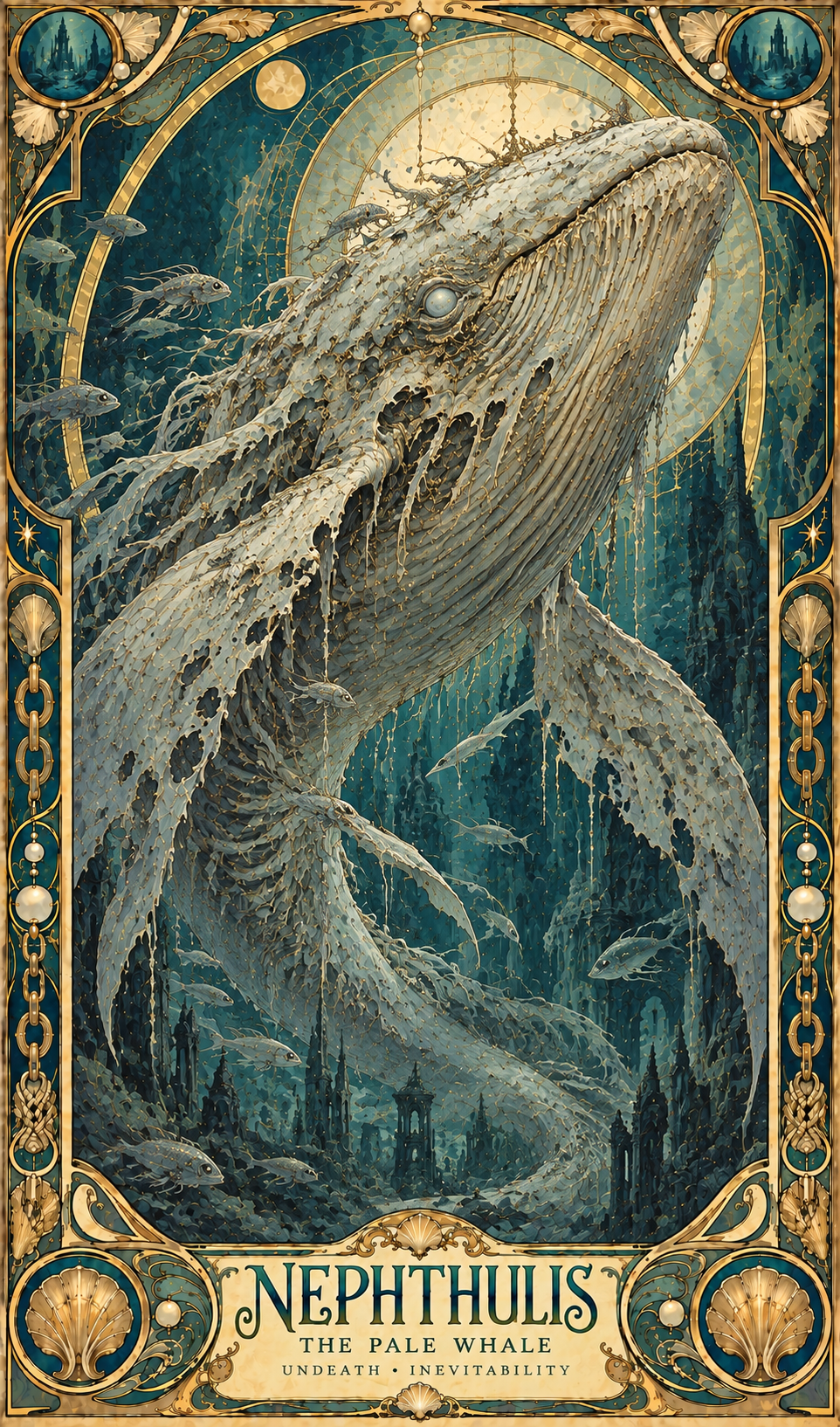
The dead whale descends, its flesh feeding the hungry, its bones sheltering the small, and its remains nourishing a community in the abyss. Nepthilus, the great undead white whale, holds dominion over the more disturbing possibility: that death may continue to act upon the world long after life has ended.
The Terrible Generosity of Death
To the worshippers of Nepthilus, the whalefall is both a natural wonder and a sacred revelation. Death is not empty. Flesh, bone, memory, and labor may remain after the life that bore them has gone. What the living should be permitted to ask of those remains is the source of the faith's deepest controversy.
The fallen leviathan gives its flesh to the hungry, its bones to the shelterless, and its final breath to the silence of the deep.
What, then, shall we give when our own breath ceases?
And what may yet be asked of those who have already given everything?
— The Terrible Generosity of Death, a maxim of Nepthilian necromancers
One practitioner hears an appeal to voluntary service and self-giving. Another hears a claim that even the dead owe a further duty. The words can offer consolation or excuse appalling acts; neither reading has erased the other.
The Cathedrals of the Abyss
All whalefalls are sacred to Nepthilus, though they are not all supernatural. Many are natural places of astonishing abundance. The oldest and greatest, however, are spoken of as awakened: skeletal cathedrals in which the dividing line between living ecology and undeath becomes uncertain.
Enormous ribs rise from abyssal silt like the vaulting of a sunken nave. Scavengers gather in dense and pale multitudes; worms and sponges lace the bones; cold lights gleam between the vertebrae. Pilgrims shelter in chambers fitted beneath the arches. Reliquaries and lamps may hang where flesh once hung. The whale's skull becomes an altar without ever ceasing to be a skull.
Witnesses tell of eels that move after death, colonies of worms that contract with a single purpose, and currents that pass through the ribs like a long-drawn breath. Some swear that a fallen leviathan can sing through the creatures feeding upon it. Whether these accounts speak of divine presence, necromancy, unfamiliar life, or frightened imagination is rarely agreed upon.
The Congregation Behind the Veil
Worship of Nepthilus is recognized and tolerated within Léoneth. His followers are not condemned simply for venerating the dead. Mourners visit his shrines, his clergy may be invited to funerals, and pilgrims sometimes depart openly for the deep. Yet their presence is deeply uncomfortable to most who live among the cultivated reefs and orderly cities.
They are usually discreet, sometimes profoundly secretive. The faithful need not deny whom they worship, but they seldom explain everything they do in their sanctuaries. Their oldest rites are conducted far from ordinary settlements; their priests can be reluctant to name what answers their prayers. Rumors flourish where knowledge is withheld.
Mourners and Pilgrims
Some devotees seek remembrance, grief, or communion. They may never practice necromancy at all. A pilgrimage known as the Long Descent draws them downward toward sacred whalefalls, leaving familiar waters behind.
Attendants of the Fallen
Keepers of shrines and caretakers of pilgrims maintain the great skeletal cathedrals. They preserve rites, tend offerings, and interpret the strange manifestations of their sacred places. Stories persist of attendants whose service continued long after death.
Necromancers
The most feared adherents study the lingering spirit, the animation of remains, and the preservation of memory or service beyond death. Some insist the dead must willingly give what is asked of them; others speak as though death itself grants the living a claim. These differences do not yet form a settled hierarchy or formally named sects.
Customs of the Whalefalls
The Giving is the practice of leaving sustenance, keepsakes, or other offerings to the creatures gathered at a fall. During the Vigil of Remaining, worshippers keep watch among the bones, listening for memories or voices. The more troubling rite of Borrowed Service concerns the calling of the dead to some final task; whether it is a gift, an agreement, or a violation depends upon the necromancer and upon whom one asks.
These customs are known imperfectly beyond the congregation. The titles by which the faith organizes its priests, and the extent of any central authority, are still unestablished.
An Unwelcome but Lawful Faith
In everyday Léoneth, the worshipper of Nepthilus occupies a difficult social position. Their devotion is not itself unlawful, but neighbors may fall silent when an attendant arrives or refuse to ask what was carried back from a pilgrimage. Some families welcome a mourner's comfort while fearing the necromancer standing beside them.
Their theology touches questions that other institutions would rather keep settled. Can a promise survive death? May an ancestor refuse to surrender a body or an inheritance? Can the dead be bound to obligations the living continue to enforce? The Vicariate of the Wounded King preserves sacred oaths and public records; Nepthilian practice raises uncomfortable questions about the very end of an obligation.
The Circle of Tides may study the life flourishing around a whalefall, but does not own, administer, or oversee Nepthilus's sacred sites.
Mysteries Not Yet Answered
Why Nepthilus himself remains undead; whether his condition is a curse, a choice, or something stranger; how far the consciousness of a fallen whale persists; and what precisely distinguishes an awakened whalefall from an ordinary one remain matters of myth and dispute. The name and organization of any wider priesthood are likewise unresolved.
What is known is the image: a congregation gathered beneath a leviathan's ribs, frightened by what nourishes them, listening to the dead whale sing with the voices of everything that has ever fed upon it.