

Factions · Lore
Salvager's Guild
Waverly's chartered salvage and trade authority, governing wreck claims, trade ledgers, taxation, and the fortified Stockyards.
Developed Lore
Overview
The Salvager’s Guild is Waverly’s chartered salvage and trade authority: a merchant consortium with teeth. It regulates who may legally claim wrecks, oversees and protects the movement of goods and the lawful salvage of wrecks, arbitrates trade disputes, and collects Guild levies and Crown tax.
Every major city or town hosts a fortified Guild Stockyard, where recovered goods must be logged, assessed, and cleared before they can be sold. Part marketplace, part vault, and part courthouse, the Stockyards are the administrative heart of the Guild’s power.
Through warrants, ledgers, arbitration, and taxation, the Guild’s influence extends far beyond wrecks. Merchants, captains, and salvage crews often find that it does not merely regulate trade: it shapes who prospers.
Its frontier bastion, Wrecktown, lies along the dangerous Sunderhull Reach, where storms, reefs, and shifting currents have claimed countless vessels.
The Guild Charter
The Guild operates under a Crown charter authorizing it to:
- Issue Warrants of Reclamation for registered wreck sites.
- Maintain legal custody of salvage until it is recorded in a Guild ledger.
- Enforce salvage law within designated waters.
- Tax registered salvage and trade.
- Arbitrate trade disputes related to wreck recovery and salvage commerce.
In exchange, the Guild pays a substantial levy to the Crown and recognizes royal sovereignty over Waverly’s seas.
The Queen’s founding charter established 1,000 original Guild shares, each carrying one vote in the Court of Proprietors. Whether—and by what authority—the number of shares may be increased remains unsettled.
Custody of the Charter
The Vicariate of the Wounded King preserves and authenticates the Guild’s foundational royal charter, its amendments, exemptions, and the judgments that define its privileges. The Guild keeps its own working ledgers, warrants, and commercial records; Vicariate custody does not place its Stockyards or officers under monastic command. The Crown remains the source of the Guild’s delegated authority.
Like the Circle of Tides, the Guild enjoys a legally protected sphere of exclusive operations in exchange for duties to the realm. These charters can overlap: a wreck on a cultivated reef may involve both the Guild’s salvage rights and the Circle’s ecological or professional rights. Such conflicts can require reference to old grants and royal adjudication. See the Vicariate and the Circle of Tides.
Corporate Government and Chartered Sovereignty
The Guild’s Crown charter grants it sovereignty of operation within its defined sphere: it administers salvage law, licensed wreck recovery, Guild Stockyards, and the related commercial and fiscal powers entrusted to it. These powers are exercised in the Crown’s name but through the Guild’s own officers and hierarchy. The Guild is not an independent kingdom; royal sovereignty remains the source of its charter.
Court of Proprietors
The Court of Proprietors is the Guild’s governing board. There is no separate Board of Directors above or below it.
Guild shares may be freely bought and sold. Each share carries one vote in the Court, so voting power is proportional to ownership rather than distributed equally among individuals. Proprietors determine the Guild’s corporate policy, oversee finances and major expenditures, and appoint or dismiss the Guildmaster.
Owning shares confers voting power, not authority to issue warrants, command Ironclads, or give direct orders to a Stockyard.
Guildmaster
The Guildmaster is the Guild’s highest professional executive, appointed by the Court of Proprietors rather than chosen by the Crown. The office may be reached through a career in Guild service or filled by a qualified hire. The Guildmaster implements the Court’s policy, directs the institution’s chartered operations, and appoints and oversees its Yardmasters.
The Guildmaster also holds the Salvager’s Guild seat on the High Curia, representing a chartered corporation whose leadership answers to its proprietors rather than to a territorial lord.
Yardmasters
Each major city has a Yardmaster commanding its principal Guild Stockyard and regional operations. Yardmasters are professional appointees within a centralized hierarchy, answerable to the Guildmaster, not independent regional rulers or elected local directors.
They supervise commercial administration and local enforcement through the Factors and the Marshals of the Yard. Smaller towns may operate Guild Stockyards without possessing a separate seat in the Guild’s leadership.
Chain of Authority
| Office | Responsibility |
|---|---|
| Court of Proprietors | Shareholder board; one vote per share; corporate oversight and appointment of the Guildmaster |
| Guildmaster | Chief executive, appointments, operational command, and High Curia seat |
| Yardmasters | Direct major-city Stockyards and regional Guild administration |
| Factors | Ledgers, valuations, warrants, commercial disputes, and taxation |
| Marshals of the Yard | Command local Ironclads and enforce Guild law |
| Wreck Captains | Command major recovery operations and their assigned security crews |
The Court governs through the Guildmaster; an individual proprietor cannot bypass the executive chain of command to direct Guild officers.
Figures of the Guild
Guildmaster Tharos Velcrum
An elderly Triton and veteran of the Ironclads, Tharos Velcrum rose from Keelguard service into the Factors’ ranks and, after decades of experience, to the Guildmaster’s office and the High Curia. He respects the Ironclads’ difficult duty, acknowledges misconduct, but resists their blanket condemnation.
Yardmaster Jhetta Krakengaurd
Heir to the Krakengaurd family, the Guild’s largest shareholder, Jhetta gained the Wrecktown post through her family’s influence but has more than justified it through the Stockyard’s exceptional performance. An ambitious reformer, she challenges the Ironclads’ notorious reputation and seeks rigorous, fair enforcement.
Tharos and Jhetta share mutual respect and admiration, even when their convictions about enforcement and the Guild’s future differ.
The Stockyards
For a detailed account of their buildings, operations, and regional network, see Guild Stockyards.
Guild Stockyards serve as administrative headquarters, salvage intake yards, auction houses, trade hubs, vaults, and barracks for the Ironclads.
Built from salvaged hull timbers, coral buttresses, leviathan bone, and reinforced shell plating, these yards look rough and improvised from a distance but are fortified and meticulously organized within.
All salvage must be entered into the Stockyard Ledger before it can be legally sold. Until then, recovered goods remain in Guild custody.
Wrecktown
Wrecktown is the Guild’s most notorious frontier outpost. Along the Sunderhull Reach, it serves as both salvage port and law-enforcement hub for the kingdom’s most dangerous wreck waters. It currently functions as the Guild’s most influential seat of power.
Fortunes are made and lost quickly here. Rival salvage crews, opportunistic merchants, and Guild officers compete in a tense balance between profit and order.
Salvage Law
Warrant of Reclamation
A wreck must be registered and a salvage warrant issued before salvage operations may begin.
Declaration of Discovery
A newly discovered wreck must be formally declared at the nearest Stockyard. The discoverer presents proof of its location and condition to a Factor, who records the wreck and issues the first Warrant of Reclamation.
The reporting party receives finder’s rights, giving priority claim to the salvage or a negotiated share of its value if another crew makes the recovery.
Doctrine of Custody
Recovered goods remain Guild property until recorded in the Stockyard Ledger, where taxes and levies are assessed before profits are distributed.
Crown and Order Claim
Artifacts of divine or royal significance must be surrendered for review by the Crown and the Holy Order of the Wounded King.
The Ironclads
The Ironclads are the Guild’s enforcement arm. They guard Stockyards, secure salvage sites, escort valuable cargo, and ensure Guild law is respected.
The most common posting is the Keelguard, named for their work guarding wreck sites where shattered keels lie across the seabed.
Ironclads take their name from salvaged iron coins recovered from surface-dweller wrecks. Stamped with the Guild crest, the coins serve as marks of service. Some are fixed to shellplate armor or stitched into uniform straps; officers may wear them as medallions.
Ironclad Armor
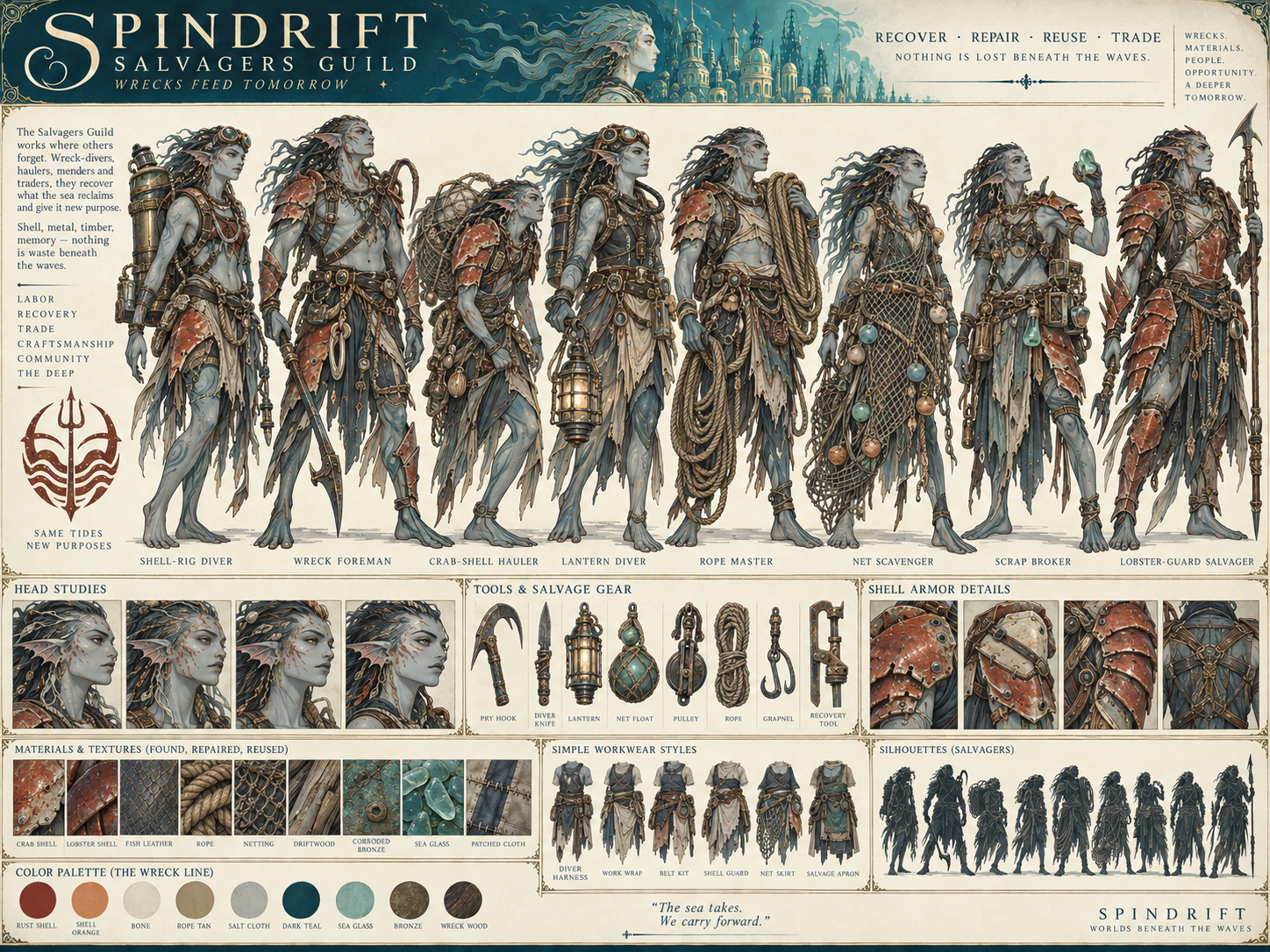
Heavy suits combine reinforced crustacean shell with salvaged metal fittings, coral plates, and bone. Curved shell segments deflect blows and distribute pressure underwater. Polearms and heavy pry bars serve both enforcement and wreck work.
Ironclad Ranks
| Rank | Duties |
|---|---|
| Keelguard Deputy | Entry-level patrol, inspection, and enforcement |
| Warrant Officer | Executes warrants and seizes illegal salvage |
| Watch Sergeant | Leads patrol squads and incident response |
| Ledger Warden | Directs Stockyard operations, records, deployments, and security |
| Wreck Captain | Commands security and recovery at valuable wreck sites |
| Marshal of the Yard | Highest Ironclad authority within a Stockyard and its region |
A Wreck Captain is especially admired within the Guild for leading hazardous, high-value salvage operations that can bring immense wealth.
Ironclads distinguish between rank and detail; officers may rotate between assignments.
Ironclad Details
| Detail | Assignment |
|---|---|
| Yard Detail | Protects Stockyards, Guild property, and ledgers |
| Escort Detail | Guards valuable cargo, salvage, and personnel in transit |
| Warrant Detail | Enforces warrants, seizures, and action against illegal crews |
| Wreck Detail | Secures salvage sites and protects recovery crews |
Factors
Factors are the Guild’s commercial officials. They register discoveries, issue warrants, value recovered goods, supervise auctions, arbitrate disputes, and collect Guild levies and Crown tax.
Where Ironclads enforce Guild law, Factors interpret it. A Factor’s seal can authorize Ironclads to seize goods, secure wreck sites, or enforce embargo decisions.
The Guild at the High Curia
The Guild holds a seat on Leoneth’s High Curia because its Crown charter places substantial economic and administrative power in Guild hands. Its records and officers are involved in salvage claims, cargo movement, trade disputes, and collection of money owed to the Crown. Decisions at court about trade and maritime enforcement directly affect the system it administers.
The specific title and method of appointment of the Guild’s Curia representative have not yet been established. The representative speaks for an institution whose interests can sometimes diverge from those of independent crews, merchants, and even the Crown.
Reputation and Controversies
The Guild’s usefulness does not make it universally admired. Ironclads are accused of intimidation and sanctioned thuggery: bullying independent crews, enforcing authority aggressively, and making harsh examples of poachers and smugglers.
Critics argue that the Guild’s monopoly on lawful salvage and its grip on trade arbitration let it determine who flourishes and who fails simply by delaying warrants, adjusting taxes or tariffs, imposing embargoes, or ruling against a merchant.
Ironclads are not an army, but their reputation for procedural brutality discourages challenges. Yet without the Guild, the wreck waters could more easily descend into piracy, and merchants and salvage crews would be left more exposed to brigands and thieves.