Stewards of the Living Sea
The Circle of Tides is one of the sea’s oldest and most quietly powerful institutions. Its druids are devoted not to a single god, but to the living cycles of the sea itself. They cultivate the kelp forests that feed cities, tend pearl beds that sustain the kingdom’s currency, shape coral infrastructure, breed sea-beasts, provide healing, protect wild reefs, and oversee the return of the dead to the sea.
The Crown relies upon their harvests and pearl cultivation; the Salvagers’ Guild depends upon the creatures and reefs they nurture. The druids rarely seek political power. Their influence arises from something more fundamental: those who grow the world hold power whether they desire it or not.
The Moots
The Circle is governed from the bottom upward through regular gatherings called Moots. Local Moots allow druids in groves, reefs, and settlements to consider the concerns of their communities. Order Moots reconcile these positions and appoint a Speaker to carry each Order’s collective judgment to the Confluence.
The process is deliberately patient. Questions may pass repeatedly between Moots before they can be resolved; no individual leader can simply command the others to agree.
The Confluence
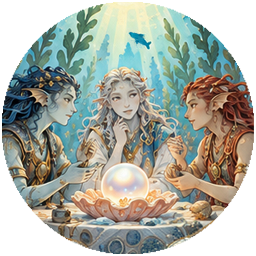
The Confluence names both the Circle’s highest deliberative body and the ancient meeting basin where its seven Orders gather. Living coral, gentle currents, and the work of generations have shaped a place of quiet beauty. The seven Speakers convene there as equals, surrounded by the living sea they are sworn to steward.
Each Speaker is appointed by their own Order Moot, accountable to that Order and equal in standing to the other six, regardless of differences in wealth, influence, or number.
The Seven Orders
The Circle reveres the sea’s interwoven cycles, but each Order has a favored divine patron and a particular responsibility.
Kelpkeepers
Speaker: Kelpspeaker · Favored patron: Tyche, Prince of Tides
The Kelpkeepers cultivate the forests that feed settlements and fleets, preserve food reserves, and harvest kelp into durable trade bales. Widely considered among the wealthiest Orders, they dress in subdued greens, olive, muted gold, and dark seaweed reds. Their exceptional kelp cloth and sea-silk reveal wealth through craftsmanship rather than display.
Pearl Tenders
Speaker: Pearlspeaker · Favored patron: Leucosia, the Siren Goddess
The Pearl Tenders protect the pearl beds that provide currency, overseeing breeding, cultivation, and careful harvesting. Their cream, silver, and shell-white garments, delicate tools, and strands of pearls reflect the measured, ritual character of their work.
Coral Shapers
Speaker: Coralspeaker · Favored patron: The Fisher King
The Coral Shapers guide reefs into walls, harbors, towers, and living buildings, sometimes over generations. Their clothing bears coral plates and branching ornaments in warm reef colors; their combs, rods, and growth hammers guide structures that can outlive their makers.
Shepherds
Speaker: Beastspeaker · Favored patron: Ephyra, Dame of Waves
The Shepherds breed and tend rays used for travel, crustaceans employed by salvagers, hippocampus mounts ridden by knights, and other domesticated sea-beasts. They preserve breeding lines and migration routes, favoring practical rayskin harnesses, shell buckles, and blue-gray or teal clothing.
Menders
Speaker: Heartspeaker · Favored patron: Tyche, Prince of Tides
The Menders heal the sick and preserve medicinal knowledge, cultivating healing algae, sponge dressings, and restorative salves. Flowing robes of seafoam, pale jade, and soft blue, along with herb nets and sponge satchels, suit their work. Their compassion draws many young initiates to the Circle.
Wardens
Speaker: Wildspeaker · Favored patron: Myrlgana, the Abyssal Queen
The Wardens protect wild reefs, predator territories, fragile ecosystems, and waters beyond settlement. Their reverence for Myrlgana and the unshaped sea is controversial within the Circle. Weathered by wilderness patrols, they wear rayskin, shell armor, grasses, and predator-tooth charms.
Stewards
Speaker: Ebbspeaker
The Stewards tend the Circle’s communal stores, seed reserves, and provision arrangements, while conducting rites that return the dead to the sea. To them, death is transformation. Dark kelp and ash-gray robes, shell beads, and coral ash distinguish their solemn work. The sacred whalefalls of Nepthilus are not Circle Holdings or sanctuaries under the Stewards’ care. The Stewards’ favored divine patron remains to be established.
Consensus and Obligation
The Confluence seeks consensus, not majority rule. Its Speakers continue deliberation until every Order can accept a course, even if some retain reservations. Disputes can return to Order and Local Moots for further consideration.
Once consensus is reached, each Speaker must uphold the collective decision, even when it contradicts their personal convictions. A Speaker represents the judgment of their Order, not their own private preference.
The Tidespeaker
The Confluence appoints a Tidespeaker to represent the Circle before the Queen in Leoneth’s High Curia. The representative may be one of the seven Speakers, or another druid chosen for expertise or exceptional circumstances.
The Tidespeaker may advise and negotiate, but cannot bind the Circle beyond the authority entrusted by the Confluence. The office grants no superiority over the seven Orders; the Confluence may recall or replace its representative.
Chartered Trades and the Estates
The Circle’s seven Orders are more than fellowships of druids: they are chartered professional bodies, entrusted by the Crown with exclusive authority over the skilled practices within their respective callings. The Kelpkeepers license commercial kelp cultivation; the Pearl Tenders oversee professional pearl breeding and harvesting; and the Coral Shapers alone certify the cultivation and shaping of living coral for construction. The Shepherds regulate specialist breeding and training of working sea-beasts, the Menders professional healing and medicinal preparations, and the Wardens recognized ecological surveys and protected-habitat stewardship. The Stewards’ authority concerns the Circle’s communal stores, its own provisioning arrangements, and its funerary practices—not a claim over sacred whalefalls or a monopoly over all trade and warehousing.
A chartered monopoly is not ownership of the land or water in which a profession is practiced. Noble houses, towns, families, and the Circle itself may hold kelp meadows, pearl beds, coral gardens, and other productive estates. A noble proprietor receives the fruits of an estate, but its specialized work must be directed or performed by duly recognized members of the appropriate Order. Local Moots protect members’ interests and negotiate terms of service, while Order Moots govern qualifications and professional standards. Everyday subsistence gathering is not treated as a licensed commercial trade.
Holdings and Stewardship
The Circle maintains its own Tidehouses, teaching grounds, nurseries, healing sanctuaries, and sanctified preserves. Other lands are held through ancient endowments, while many of its members spend their working lives tending estates belonging to noble or civic proprietors. Shared Current Houses may serve travelers and keep observations of the sea’s changing conditions. The Confluence remains the common meeting basin of the seven Orders, not the private estate of any one of them.
These distinctions matter in the realm’s reckoning of Holdings: a pearl bed owned by a noble house does not become Circle property because Pearl Tenders cultivate it. The Circle’s separate asset is its chartered right to practice and its network of skilled members.
Privilege and the Duty of Service
The Orders’ exclusive privileges carry reciprocal duties. They must maintain skilled practitioners, train successors, respect lawful agreements, and preserve essential services upon which the realm depends. A general cessation of work can imperil the charter itself, making collective negotiation, petitions, and arbitration more usual than kingdom-wide strikes. The Crown cannot casually extinguish ancient privileges, but the Circle cannot assume that a royal monopoly is beyond legal challenge. Individual members may still contest abusive or dangerous conditions.
The Vicariate of the Wounded King keeps and authenticates the royal instruments under which these rights are exercised. The working name “Charter of the Seven Tides” is used for the Circle’s foundational grant; the historical form of its surviving instruments remains to be developed. See the Vicariate’s account of sacred obligations.
The Circle and the Crown
To realm lords accustomed to personal command, the Circle’s patient deliberations can be maddeningly slow. Even an urgent royal demand may have to return through the Moots. Yet no single druid can surrender its authority under pressure. Its strength is the considered consent of seven independent Orders, each charged with protecting something upon which the kingdom depends.
Reputation and Dissent
The Circle inspires gratitude, dependence, and no small measure of suspicion. It heals the sick and feeds cities, but also closes exhausted pearl beds, restricts damaging harvests, and forbids expansion into vulnerable reefs. With the Fisher King wounded and the sea sometimes faltering, such judgments can shape the fate of whole communities.
Coris Thalven, a young Mender known for warmth and relentless idealism, believes the Circle has become too slow and set in its ways to answer famine, blight, disrupted migrations, and unrest. Common people often admire his sincerity; older druids consider him promising, troublesome, or both.